Introduction to Web development

Web development is the process of designing, building, and maintaining websites and web applications that run on the internet. It blends technical skills with creative problem-solving to ensure websites are visually appealing, functional, and provide a smooth user experience across various devices and browsers. also explain the difference between HTML,CSS and JAVA SCRIPT IN WEB DEVELOPMENT.
Types of web development
Web Development is the process of creating and maintaining websites and web applications through internet. It includes designing the layout, writing code, and managing the functionality of a website so users can easily interact with it.
- Front-End Development (the visual part users see, made with HTML, CSS, and JavaScript),
- Back-End Development (the server, database, and logic that make the website work)
- Full-Stack Development (a combination of both front-end and back-end).
The scope of web development is important because every business, organization, and individual needs an online presence today.
HTML ,CSS ,java script: Complete Guide for beginners
What is HTML?
HTML (HyperText Markup Language) is the standard language used to create the structure of web pages. It helps organize website content such as headings, paragraphs, images, and links.
Steps to Create a Simple HTML Page
- Step 1: Create an HTML File
Open a text editor and save the file with the .html extension. - Step 2: Add Basic Structure
Use basic HTML tags like html, head, and body to create the webpage structure. - Step 3: Add Content
Insert headings, paragraphs, images, and links to display information on the webpage. - Step 4: Open in a Browser
Save the file and open it in a web browser to see your webpage.
What is CSS in web development?
CSS is responsible for the visual appearance of a webpage, transforming plain HTML structures into visually appealing and responsive designs.
- Separation of Concerns: CSS allows developers to separate the structure and content (HTML) from the visual presentation, making the codebase more organized, maintainable, and efficient.
- Aesthetics and Design: With CSS, you can define colors, fonts, text sizes, spacing, backgrounds, and margins.
- Layout and Positioning: It provides tools like Flexbox and CSS Grid to create multi-column layouts and position elements precisely on the page.
- Responsiveness: CSS uses media queries and flexible layouts to ensure web pages adapt seamlessly to different devices and screen sizes (e.g., desktops, tablets, and smartphones).
- Interactivity and Effects: It enables the creation of subtle animations, transitions, and hover effects to enhance user interaction.
How CSS Works?
A CSS style sheet consists of a list of rules that the browser interprets to style the content http, css and javaScript work collaborate :
- Declaration Block: Contains one or more declarations enclosed in curly braces ({}).
- Declaration: A property and a value pair separated by a colon (e.g., color: blue;).
WHAT IS JAVA SCRIPT?
JS stands for JavaScript, a high-level, dynamic programming language and one of the core technologies of the World Wide Web, alongside HTML and CSS. It is used to make web pages interactive and dynamic furthermore javaScript can enhance your web development skills.
How JavaScript Makes Websites Interactive in web development
JavaScript adds interactivity and dynamic behavior to websites, making them more engaging for users.
1️⃣ User Actions
JavaScript responds to user actions like clicking buttons, typing in forms, or hovering over elements.
2️⃣ Form Validation
It checks user input in forms (like email or password) before the form is submitted, improving user experience.
3️⃣ Dynamic Content Updates
With JavaScript, website content can change without reloading the page, such as showing new messages or updating data.
4️⃣ Animations and Effects
It can create sliders, pop-ups, dropdown menus, and animations that make websites look modern and interactive.
5️⃣ Real-Time Features
JavaScript enables features like live chat, notifications, and real-time updates.
Key Features and Purpose of javaScript
- Interactivity: JavaScript enables dynamic behavior on web pages, such as interactive forms, animations, drop-down menus, and real-time content updates. Without it, websites would be static.
- Client-Side Execution: Primarily, JavaScript runs on the user’s web browser (client-side), which allows for faster response times without needing constant communication with the server.
- Versatility: While it started as a front-end language, the introduction of runtime environments like Node.js allows JavaScript to be used for server-side development, game development, mobile applications (via frameworks like React Native or Electron), and even AI and VR applications.
- Integration with Web Technologies: It integrates seamlessly with HTML (structure) and CSS (styling), allowing developers to manipulate the page’s structure and appearance through the Document Object Model (DOM) API.
- Dynamic Typing: JavaScript is a dynamically typed language, meaning variables can change data types at runtime, which offers flexibility in coding but requires careful handling in large projects.
- Large Ecosystem: It has a vast ecosystem of libraries and frameworks (e.g., React, Angular, Vue.js, jQuery) that provide pre-written code to speed up development.
Difference between HTML,CSS and JAVASCRIPT
Detailed Breakdown
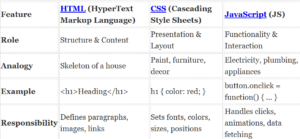
HTML, CSS AND JAVASCRIPT EXPLAINED :How to do They WORK TOGETHER
1️⃣ Role of HTML
The role of HTML is to create the basic structure of a web page by organizing content such as headings, paragraphs, images, and links.
2️⃣ Role of CSS
CSS is used to style and design the webpage.
It controls colors, fonts, layout, spacing, and responsiveness of the website.
3️⃣ Role of JavaScript
JavaScript adds interactivity and functionality to the website.
For example: sliders, form validation, animations, and dynamic content.
4️⃣ How They Work Together
Key Reasons for Importance
- Dynamic Functionality & User Experience (UX): Modern sites are not static. These languages allow for dynamic, interactive user experiences (e.g., logins, real-time updates) that enhance engagement.
- Universal Browser Support: HTML, CSS, and JavaScript are natively understood by all web browsers, ensuring compatibility across different devices and platforms.
- High Performance & Speed: Back-end languages (like Python, PHP, Java) are vital for managing data and ensuring fast loading times, which is critical for user retention.
- Innovation and Flexibility: These languages enable developers to build complex applications, including VR, IoT devices, and progressive web apps, driving web technology forward.
Pingback: best web development institute in gujrat - adan4.aitechprojects.net